As China ages, millions of parents who raised only one child are entering later life. Compared with older adults who have multiple children, they may face greater concerns about future care, financial security, and social support. In response, China introduced the Elderly Family Planning Subsidy (EFPS), a program that provides financial assistance to eligible older adults from one-child families.
In our new study published in the Journal of Aging & Social Policy, we examined whether this policy was associated with better health outcomes among older Chinese adults. Using nationally representative longitudinal data from the China Health and Retirement Longitudinal Study (CHARLS), we followed 1,981 subsidy-eligible older adults and compared recipients with similar non-recipients.
Measuring Policy Impact
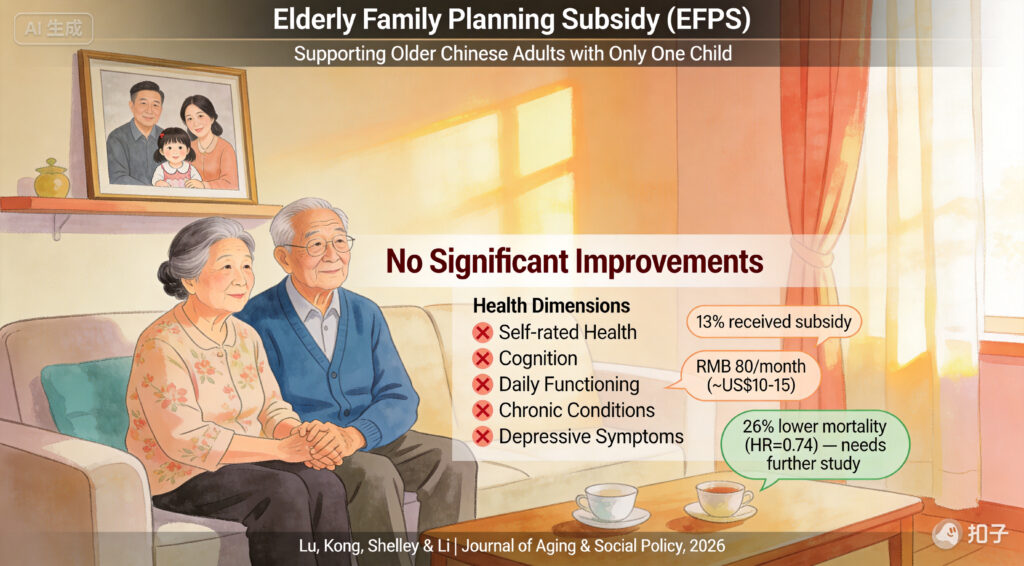
The findings suggest that the EFPS has not yet translated into measurable improvements in health outcomes. We found no significant differences between subsidy recipients and comparable non-recipients in self-rated health, cognitive function, daily functioning, chronic disease burden, depressive symptoms, or overall mortality.
These findings are important because the EFPS was introduced to help address the unique challenges faced by older adults from one-child families, a population that may have fewer sources of family support as they age.
Why Might the Policy Be Falling Short?
Our study points to several possible explanations.
First, only 13% of eligible older adults reported receiving the subsidy, suggesting that many intended beneficiaries are not being reached.
Second, the level of financial support remains modest. Among recipients, the median benefit was approximately 80 RMB (US$10-15) per month, which may be insufficient to produce meaningful changes in health and well-being.
Together, these findings highlight the challenges of translating policy intentions into tangible health benefits.
A Signal Worth Further Investigation
Although the overall findings were largely null, one result deserves attention.
Subsidy recipients experienced a 26% lower mortality risk than matched non-recipients (hazard ratio = 0.74). While this difference was not statistically significant, likely because of the relatively small number of subsidy users and limited follow-up period, it points to a potentially beneficial direction that merits further investigation.
Future studies with larger samples and longer follow-up periods will help determine whether this pattern reflects a meaningful long-term benefit of the program.
Looking Ahead
As China continues to age, support for one-child parents will remain an increasingly important policy issue. Our study provides some of the first national evidence on the effectiveness of the EFPS and suggests that improving coverage, accessibility, and benefit levels may be necessary to better support healthy aging among this growing population.
Reference
Lu, P., Kong, D., Shelley, M., & Li, C. (2026). Health Effect of Elderly Family Planning Subsidy on Older Chinese with Only One Child. Journal of Aging & Social Policy, 38(2), 240-258. https://doi.org/10.1080/08959420.2024.2422659
Source: Peiyi LU, Associate Director of CoA
Email: peiyilu@hku.hk